Using personas for target audience assessment

Identifying the target audience is an integral part of training needs analysis. It gives the opportunity to look into performance gaps but also gives you an idea of how training will be conducted to bridge the training gap.
Here is a tool that was borrowed from marketing to help you connect to the learner in order to create a meaningful learning experience.
Personas are fictional, but provides you and other training developers an idea of who the learner is going to be. It also provides a sense of the learning experience from the eyes of the trainee.
Creating a persona is done by gathering information and conducting audience interviews.
Collection of the information needs to be written down in your design document as it will help with the experience design.

Here are some of the main items to consider:

  • What does the learner do in the workplace
  • Demographic information (age, language, local/global)
  • Attitude towards learning/performance
  • How they learn (tools and learning environment)
  • Training availability

It is recommended to:

  • Add an image
  • Create a couple scenarios and apply what you think what would the persona do

Here’s an example of personas created for training:

Unlearning

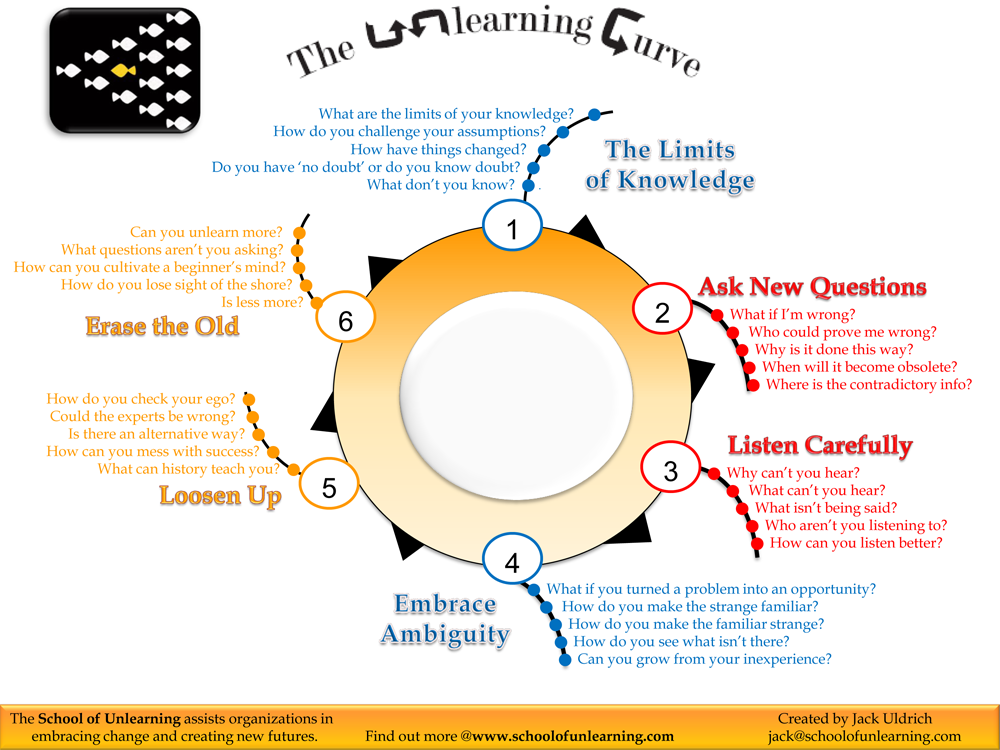
In our life we face every once in awhile a situation that require us to change our ideas, knowledge or behaviour. In 2006, scientist declared that 76 years after it’s discovery Pluto is not a planet we had to face the fact that our teachers, textbooks and even scientist are wrong. Or were they?… A child learns not to grab a toy from another one and learns to ask, or a new safety regulation makes us work with safety equipment never used before, even how we use our smartphone required from us a lot of mental flexibility.

Jack Uldrich from www.schoolofunlearning.com crated an infographic to capture questions that will ease a change for an individual.

http://ajjuliani.com/wp-content/uploads/2015/12/The-Unlearning-Curve-Framework-.png

Which questions would you incorporate in your training to ease the adaptation?​

Grit – What if it’s not only IQ?

We all want to be successful. At home, at work or at any activity we like. According to Angela Duckworth a mix of passion and perseverance which she calls “Grit”, is a measurable predictor of success in achieving one’s goal. Angela found in her grit research that grit can be developed. Even though her research focuses on young learners it seems that it is also tunes in with adult learners and the workforce. This is not only WIIFM, this is innate commitment to accomplish your goals. Ted talk here: https://www.ted.com/talks/angela_lee_duckworth_grit_the_power_of_passion_and_perseverance Book Website: https://angeladuckworth.com/grit-book/ Test your grit:https://angeladuckworth.com/grit-scale/

Performance Analysis

Instructional designers are often encountering clients who are frustrated with the performance of their employees. By the time they approach you they think they already realized the best way to solve the performance issue… training!

In one of my roles I was asked to develop a handwashing training refresher for healthcare professionals in the hospital setting. I was told I am to continue the work of a previous designer on an eLearning module. The module was almost ready and it detailed beautifully the importance of handwashing (WIIFM), vivid video demonstrations and a well written quiz.

When I inquired about the performance deficiency, I found out that the staff actually knows how to wash their hands and are aware of its importance in order to reducing cross contamination.

Where is the problem then? Talking to some nurses I found out that if you work according to the hand-washing guidelines you will end up washing your hands 20 times an hour.

Washing your hands is:

  • Time consuming – about a minute every time you touch a new environment
  • Boring – you have to scrub your hand for at least 15 seconds(it is longer than you think, try it..)
  • Hurts – the soap irritates the skin and gloves with talcum in them dry the skin further

So it seems that the suggested fix was not really about training.

Before jumping to a training solution it is wise to look into the real issue at hand.

A classic approach is the Mager and Pipe approach to look into the issue at hand. Here is a link to the workflow on HPT website . If you want to read more, “Analyzing Performance Problems, Or, You Really Oughta Wanna” it is the first book in the classic Mager 6-pack.
A more concise approach can be found in Jean Barbazette book “Training Needs Assesment“.


What is ISD (Instructional System Design)?

ISD or Instructional System Design is a systematic approach to creation of training that focuses on the training result. The ISD guide the designer to ensure all required steps for the creation of training are being considered.

There are various ISD models:

  • ADDIE
  • KEMP
  • Dick and Carey
  • SAM
  • and more

The most commonly quoted ISD is ADDIE. ADDIE stands for:

  • Analyze
  • Design
  • Develop
  • Implement
  • Evaluate

ISDs genrally include all the above elements, just organized a little bit differently.

DIY eLearning

On multiple occasions designers approached me in the past saying they would like to add eLearning as a skill. Taking a course can be time consuming and expensive which is hard to do while working. I am always happy to sit and guide a fellow designer through a small project, where they get to use several of the main features of one of the authoring tools (e.g. Captivate, Storyline).

My recommendation on starting by yourself is:

  • Select an authoring tool
  • Download a trial
  • Run through basic tutorials
  • Create a small project to demonstrate your abilities
  • Continue your learning by:
    • Videos and other tutorials
    • Get ideas by reviewing other designers work (Learnfest ect.)